Showing posts with label classmates. Show all posts

Friday, October 14, 2016

Sherman Hotel once “largest hotel west of Minneapolis”


The Sherman House was one of Aberdeen’s first and longest running hotels, opening in 1881 just one month after the town’s founding, and serving the
Sherman House
traveling public for nearly one hundred years. Sherman House opened in grand style with approximately 160 people in attendance.


Guests danced in the spacious dining room; refreshments were served about midnight. Following that, several speakers addressed the crowd. The dancing continued until the
Sherman House Lobby
“wee small hours.” Everyone in attendance declared the opening to be “the most enjoyable event of the season” and congratulated owner James Ringrose on opening one of the finest hotels in the area. The hotel was large enough for 100 guests and boasted a well-stocked bar, a large billiard room, and a livery stable. The Sherman House quickly became the center of many of Aberdeen’s social events. Mr. Ringrose expanded his hotel in 1887 with a brick addition, which increased his capacity by 43 rooms.


Nearly 20 years later on the night of November 22, 1906, fire destroyed the Sherman House. Oddly enough, the brick section was totally destroyed, but the original frame building was relatively untouched. Newspapers claimed, “Practically every resident of Aberdeen not sick in bed or too aged to appear was on Main Street and the adjoining avenues watching the fire.” The hotel was quickly rebuilt on the same site as the original, the corner of 3rd Ave and S. Main St. A grand opening and ball was held in November of 1908. A huge crowd numbering nearly 1,000 was
Sherman Hotel
in attendance, and three orchestras provided dance music throughout the evening. The new Sherman House was a four-story building with 120 guest rooms and 50 baths, most placed between two guest rooms. In addition, each hall had a public toilet. Room rates were $1 and up per night.

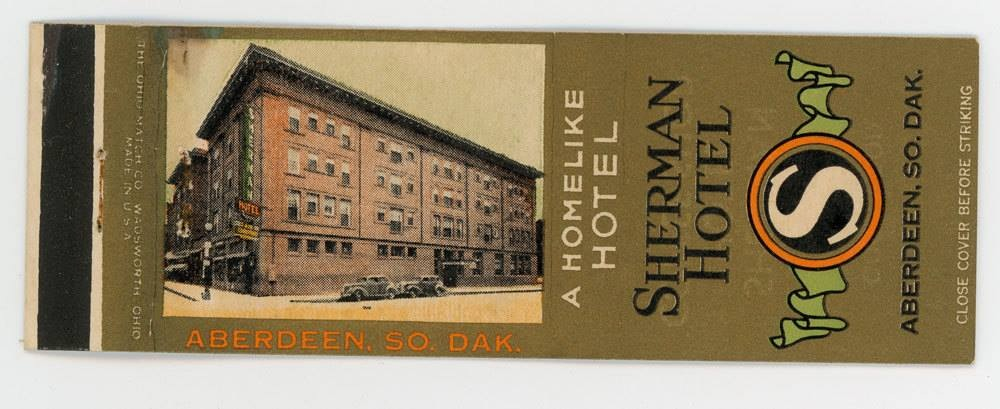
Sherman Hotel Matches
Another fire occurred on the night of June 26, 1926, destroying the entire north wing. Again the owners rebuilt the Sherman Hotel, reopening it for business later that same year. In 1966 the upper three floors of the Sherman Hotel were removed, and its new roof would serve as the parking deck for a new downtown parking ramp. The hotel’s first floor became a connecting point to the ramp. The original frame structure, still located on Lincoln Street, was demolished as part of the parking ramp construction.  

In 1977 what was left of the hotel was demolished along with the ramp to make room for a planned low-income rental complex. Finally, in 1980 the Sherman Apartments, a 51-unit housing facility for the elderly, was built on the site.


Pictured are two building photos, one from 1920s and one from 1950s. Interior lobby photo from 1950.

Tuesday, September 20, 2016

Here's Looking at You, Kids: The Fluoroscope Was a Shoe Salesman's Best Friend


By Carole Tonigan


When my brother, Butch, and I were in elementary school, my father was manager of the Sears department store in downtown Aberdeen. On Sundays when the store was closed, he frequently would take my brother and me to the store to give Mom a break. 

We always had some type of adventure exploring the store while there were no employees or customers there. In the shoe department there was an X-ray machine. 

It was about four feet high with viewers at the top and a slot at the bottom where your foot was inserted to assess the fit of your foot in a shoe. We witnessed the machine at work on customers many times during a regular business day. On some of these Sundays, we had the shoe department to ourselves while Dad was upstairs doing paperwork. 

We loved this futuristic machine. Since we could not "view" our own feet because we were not tall enough, we would take turns viewing each other's hand or foot. We thought it was such fun to wiggle our toes and fingers for the other one to see. 

I can’t recall how long the machines were at the store or whether other stores had them, but apparently it became evident later that they were not safe and our Sunday toys were removed from the store — and other shoe stores around the country. 

Oh, the things we did that we didn't know were risky at the time.


And then there were thermometers with mercury ...


Editor's Note: Following is a story in Smithsonian magazine about the kind of machines Carole is talking about.

                          —————————————————————

By Karen Larkins, Smithsonian Magazine

If you were born anywhere between 1920 and about 1950, you probably recall an odd-looking cabinet that once lured customers into shoe stores across the country. 

The shoe-fitting fluoroscope used cutting-edge technology—the x-ray—to reveal the bones and soft tissue of the foot inside the shoe, ostensibly for a better fit. For three decades beginning in the mid-1920s, millions of children and adults in the United States, Europe and other parts of the world peered into the machines for an inside view of their usually wiggling toes. 
Pedoscope

In 1986, the National Museum of American History acquired a fluoroscope, one of perhaps only a handful extant, from a shoe store in northern Ohio. The mid-1930s vintage, walnut-cabinet machine was one of thousands produced by the Adrian X-Ray Company of Milwaukee, Wisconsin, a leading manufacturer of the devices.

From the start, the fluoroscope, invoking the authority of modern science and technology to sell more shoes, functioned more as sales gimmick than fitting aid. O. C. Hartridge, who founded the other major fluoroscope manufacturer, England’s Pedoscope Company, understood the power of this marketing ploy. The machines, he wrote in 1937, proved a "valuable ally of the retailer. By enabling him to demonstrate the correctness of his fitting, it permits him to impress customers with the reliability of his service; and in those rare instances where people insist on having shoes that are wrong, it puts the onus on them." 

Children, in particular, loved the quirky machines.
Fluoroscopes proved "as attractive and exciting to little customers as ‘free balloons and all-day suckers,’" wrote Jacalyn Duffin and Charles R.R. Hayter, in their journal article "Baring the Sole: The Rise and Fall of the Shoe-Fitting Fluoroscope." Paul Frame, a health physicist with Oak Ridge Associated Universities, in Oak Ridge, Tennessee, recalls his friends in Toronto, where he grew up, going into shoe stores just to stick their feet in the machines: "Seeing the greenish yellow image of your bones was great fun."

The device reached its peak of popularity in the early 1950s, with some 10,000 in use in shoe stores in the United States. Then, as concerns about the
potentially damaging effects of radiation grew, the machines began to disappear. (Researchers have yet to determine whether the machine was responsible for any ill effects.) Smithsonian curator Ramunas Kondratas says the fluoroscope represents "the triumph of salesmanship
over common sense and a lack of knowledge about the health consequences of certain technologies." In 1957, Pennsylvania became the first state to ban the machines. By the mid-1960s, they were history.

How do people react today when they encounter a fluoroscope? It’s mostly a matter of age. Jim Connor, a curator at the National Museum of Health and Medicine at Walter Reed Army Medical Center in Washington, D.C., where one is on display, says that "visitors over 50 have a flashback experience as they recognize the device. These things are real memory triggers."

Wednesday, September 14, 2016

Aberdeen's Auditorium Opened November 1938


What do all of the people below and the Aberdeen CHS class of 1966 have in common?

Roy Rogers, Dale Evans, Gene Autry, John F. Kennedy, Robert F. Kennedy, Richard Nixon, Jesse Owens, Ted Williams, Louis Armstrong, Johnny Cash, Jerry Lee Lewis, Nat King Cole, Neil Diamond, Kingston Trio, Martha Reeves and the Vandellas, Dolly Parton, John Denver, REO Speedwagon, The Carpenters, Three Dog Night, Willie Nelson, Merle Haggard, Charlie Daniels, Ricky Skaggs, Paul Revere and the Raiders, B. J. Thomas, The Lettermen, Gary Puckett and our very own "The New Group."


The opening of Aberdeen’s new auditorium in November of 1938 gave the city a place to host large gatherings for the first time in 36 years after a 1902 fire had destroyed the Grain Palace.

In 1934 the American Legion urged city officials to consider building an auditorium to make Aberdeen
Aberdeen Grain Palace 1883
more competitive as a convention site. In 1935 city officials prepared a Public Works Administration (PWA) application for an auditorium; it was denied. During the next two years, local officials worked to keep hopes for the auditorium alive. Finally, in 1937, organizers invited Aberdeen’s school officials to become involved, suggesting a new joint-use facility would provide much-needed additional space for student activities.


The school board became eager partners and agreed to sponsor a $150,000 bond issue for the project, which voters approved in a special election. Soon a second PWA application was prepared, submitted,

and approved. The auditorium project received a $135,000 grant and a $165,000 loan from the PWA.

The site for this facility was school-owned property adjacent to the high school. Site preparation began January 11, 1938. On May 31, students and school officials held an impromptu ceremony to lay the building’s cornerstone. By the following November, the auditorium was complete and ready for use. During the summer months,


workers remodeled the school’s old auditorium, which became the school library.

The Aberdeen school board planned a week-long open house to showcase the new facility. They invited people within a 50-mile radius to enjoy all the events during “Auditorium Week,” November 6-13, 1938. More than 11,000 people attended. A dedication program preceded the tour schedule to

recognize the efforts of those involved. Fifty-six years prior, in 1882, F.H. Hagerty and William Lloyd had donated a city block between South Washington and Jay Streets as the site for Aberdeen’s first schoolhouse. In 1911, Aberdeen Central High School replaced the original school on that property, which was adjacent to the new auditorium.

The design of the theater included an ample stage area and seating for 1,600. Colors used in the décor

were ultramarine blue, brown and gray. It was equipped with a Hammond electric organ, a Steinway concert grand piano, and a projection machine. Its potential uses included general high school assemblies, dramatic productions, grand opera and other musical productions.

The auditorium/arena balconies offered seating for about 2,000 spectators, and its open floor space, when set with chairs, provided another 3,200 seats. The massive floor was ideal for basketball games, conventions, automobile and machinery exhibits, indoor circuses, and community dances.
1950 Graduation at Civic Arena

The Aberdeen-Civic Auditorium was the first facility in the country built in a city the size of Aberdeen
Civic Theater
(17,000) to serve both the schools and the community. Even after the Aberdeen Public School system built a new high school on the south edge of town many years later, the Civic Arena and Theater continue to serve Aberdeen and the surrounding communities with events, sports, and the Yeldez Shrine Circus every April.